The fortresses of prehistoric Sardinia
In a vast area between Marmilla and Sarcidano, in south-central Sardinia, you will be enchanted by some of the Nuragic era’s most significant remains


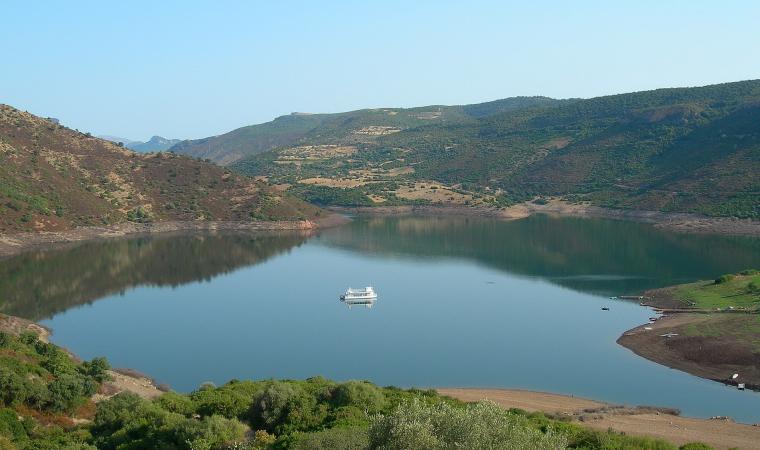
The itinerary touching on the fortresses built in the Bronze Age starts in Sarcidano with the great nuraghe Arrubiu of Orroli, which looks out over Flumendosa Lake, and goes to Marmilla, where you will see one of Sardinian prehistory’s greatest landmark, the su Nuraxi at Barumini and another impressive prehistoric construction, the Genna Maria nuraghe at Villanovaforru
Journey length: 54 km
Road travel time: 1 h 13 min
The names means ‘red’. Like the colour of the lichens that cover the basaltic rock it was built of. It rises at the centre of the Pranemuru high plain, in the historical region of Sarcidano. It is a very rare example of a five-lobed nuraghe. The main tower is surrounded by a bastion with five towers around which a protective outer wall runs with another seven towers. It contains three courtyards. All that remains of the main tower, which was originally built over two floors plus a terrace, is the lower tholos, or false dome, and a part of a room higher up, today 14 meters high (originally it was double the size). Around the outer wall are the remains of a village, three huts of which have been excavated. Eight hundred metres away is a Giant tomb.

It is Sardinia’s most celebrated Nuragic complex: su Nuraxi at Barumini. UNESCO declared it a Heritage Site in 1997 for its exceptional architecture and layout. The nuraghe and its village are at the base of the Gesturi Giara in Marmilla and underwent various phases: from the Early Bronze Age to the end of the Iron Age in the XVI-VII century BC. The main body dates to the earliest phase and its base has a diameter of 12 metres. It boasts three stories and a terrace. Around it is a bastion with four towers connected by a brick wall. The rooms of the interior of the tower were connected by stairs and sloped passageways that led to the various parts of the structure. In the half-moon courtyard was a 20 metre deep water well that supplied the entire building.

The three-lobed Genna Maria nuraghe is located in on a hilltop in the Marmilla region. Its original mandate was defence and regional control, the views from span all the way to the gulfs of Oristano and Cagliari. The original tower, of which the top is now missing, probably dates to the Middle Bronze Age (XV century BC) and is encircled by a tri-lobed bastion and hexagonal outer wall. The village is located partially inside and partially outside the outer wall.