Coastal towers, a hundred viewpoints
A glorious past, a present worthy of an Internet star and outposts overlooking the sea, where you can take the most beautiful photos


By boat, canoe or SUP, moving along one of the Island’s promontories, you might get a glimpse of a ‘surveillance’ nuraghe or an anti-aircraft battery, the legacy of last century’s wars, camouflaged by the scrub, or a medieval castle at the top of its village. You are even more likely to come across a coastal tower: about a hundred of them, built five centuries ago by the Spanish monarchy, dominate the Sardinian coastline. They are still there today, in places that were strategically ‘hand-picked’ to guarantee more control over a sea infested by Saracen pirates at that time. They climb to the edges of high rocky peninsulas that jut out over the water, covered with Mediterranean greenery and wild flowers. At their feet, a lively and colourful underwater world, a very popular place for diving and snorkelling, begins to reveal itself.
If you see a tower from the beach and can’t resist the temptation to share a good story on Instagram, you can easily get to it on foot, choosing the shortest route from your beach umbrella. It would be even more fun to reach them by mountain bike or on horseback, following the paths behind the beaches that wind through unusual landscapes, parks and lagoons, up to the top of the promontories. The views from up there are the unforgettable image of a holiday that you will take home with you.
You can walk on the seashore with the water up to your ankles along ten kilometres of free, deserted beaches. Be inspired by hot stone techniques and, after a dip in the sea, lie on the flat pebbles loaded with solar energy, to stimulate your muscle tone and circulation and smooth your skin. Feeling regenerated, you will reach the promontory of the tower and this is where the fitness session ends, with some diving from the rocks and a dip in clean, transparent waters, just like that of swimming pools.

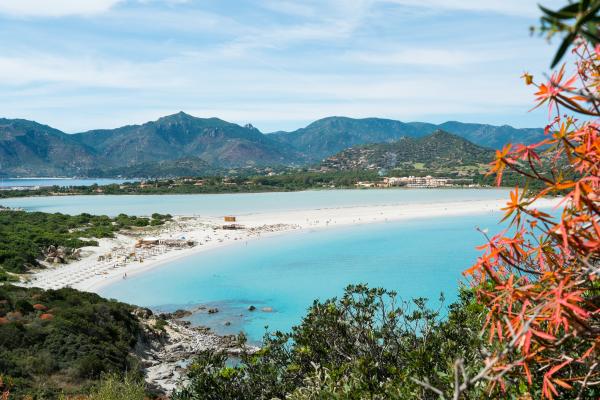
The beautiful, perfect coastal landscape of Villasimius can be experienced all year round, not just in the swimming season. So, set off with your comfortable shoes on or barefoot on the cliffs, coves and beaches of fine or grainy sands: the itineraries take you along the Pond of Notteri to the foot of Capo Carbonara. At the top, you can see a tower. It is hard to resist climbing the promontory to reach it. From up there… quiet everyone.
At Asinara, lined up on the last outpost, defending the mother island, are the towers of Trabuccato, Cala d’Oliva and Cala d'Arena and, separated by a strip of sea from the island of Piana, stands the tower of La Pelosa, a seemingly benevolent star of the Internet. A park and sometimes legendary history surround them. How can you visit them all? On foot, by bike (also e-bike) or by Jeep, from one side of the island to the other. Well done!

It is not the most beautiful nor the oldest, but its blessed overlook saved Cagliari from raids and invasions. Now on holiday, it enjoys the sea view from the city that, for some years, has been receiving a succession of awards: it is a sailing paradise for Luna Rossa, the Italian city with the best food according to Gambero Rosso, while, for those who know it, its greenery is the most enjoyable and it is a candidate for the 2023 European Green Capital Award.

From Bosa to Alghero by motorcycle or by bike, there are 40 kilometres of natural scenery with a series of alternating cliffs, crags and sparsely frequented coves that can be reached on foot. Get off your bike and follow the trails into the Mediterranean scrub. One will take you straight to Torre Argentina, surrounded by a white paradise of natural pools between rocks smoothed by the sea. Now put your mask and flippers on, before returning to the road.
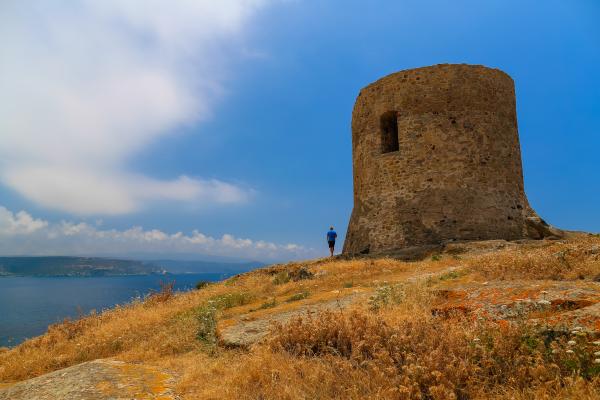
This is the Sinis peninsula, where every scenario will amaze you. There is also an ‘oasis’ inhabited by some shy little friends hiding in the cool thickets and fragrant shrubs that suddenly give way to a cliff overlooking the sea. You can stop and wait for the sunset here, next to a stone ‘lookout’, with a camera or a smartphone in your hand, as Nature is about to paint an irresistible picture.


