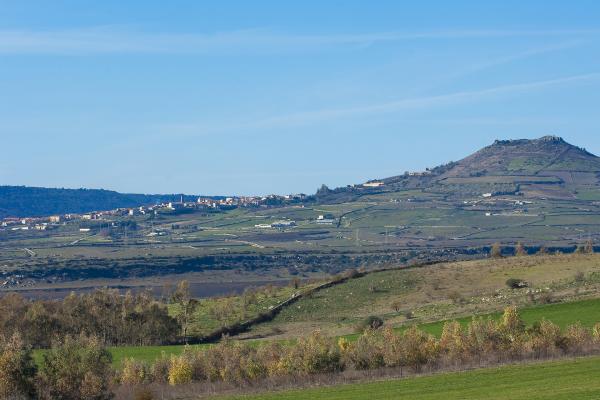
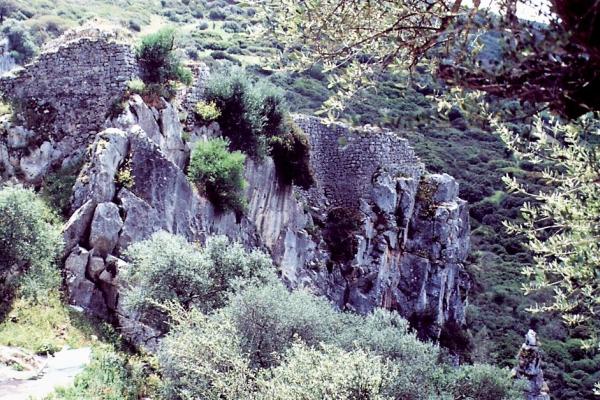
At the entrance to the town, two ancient buildings, adjacent but distant in time, draw the eye: the ruins of the tower of a Medieval castle and a large baronial palace, ‘living’ testimony of the 17th century. Senis is a small town of 450 inhabitants in Upper Marmilla territory with a glorious past, particularly as part of the Curatoria of Parte Valenza and Brabaxianna under Giudicato of Arborea. It was the ‘doorway’ to the Barbagia. Hence, around the 13th century a defensive fortress was built on the Funtana Menta hill, a natural ‘balcony’ overlooking the valley of Flumini Imbessu. The ruins of its ten-metre-tall rectangular tower and a buried space for storing water are still intact. Four centuries later, the town was chosen as a noble residence. A courtyard separates the Giudicale tower from a 1662 Baronial Palace, testimony of the central role played by the town and a repository of memories of feudal affairs.
The restored complex is composed of a two-storey villa, stables, small prison and the Is Nueddas enclosure, originally used as a garden. The present-day circular town rests on the slope of Su Casteddu. It is arranged around the 16th century Parish of San Giovanni, which houses the Altar of Rosario and the base of the main altar dating to 1608. The patron’s Feast Day is celebrated in late June with a procession accompanied by goso, religious songs to which the early October Sa Pratza de Preguntas et Torrida Congress is dedicated. The other church in the town is dedicated to saints Cosma and Damiano, whose feast day is in late September. The most anxiously awaited event is the early August Snail Festival with many tasty dishes to try.
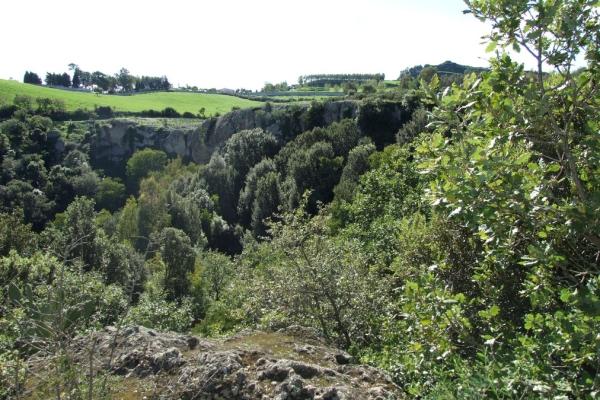
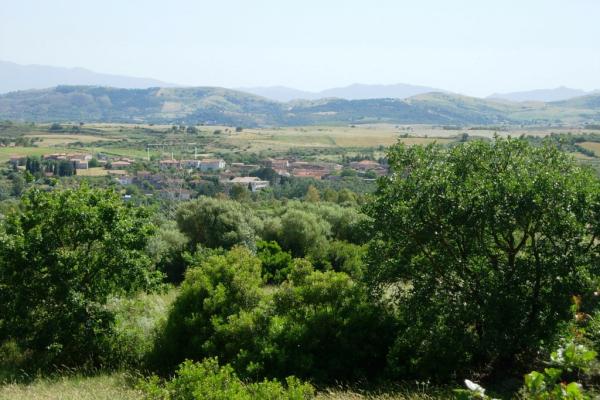
Two more rolling hills overlook the town: the hills of Giuerri and Santa Vittoria. The apex of the latter contains the remains of a mysterious building surrounded by a village where a sacrificial slab was found. The hills are covered by alternating pastures, cultivated fields, cork oak groves and Mediterranean shrubs. Shepherding produces exquisite cheeses, ricottas and meats; while the vineyards, almond orchards and groves of ancient, contorted olive trees produce renowned wines, almonds used in traditional sweets and excellent olive oil. Along the bank of Imbessu, surrounded by tunnels formed by ash trees, poplars and willows, stands the Spanish Fountain. A unique work of architecture and sculpting carved in multi-coloured trachyte by Laconian stonemasons and enveloped by the foliage of downy oaks and ivy in a fairy tale setting. It consists of a mask from the moth of which water once poured, flanked by two bas relief swans and other ornaments.
Traces of the area’s Neolithic past are abundant, especially obsidian chips and pottery fragments. The plateau is known as Bidda ‘e Perda, the country of stone. The name derives from the ruins of three Nuragic towers, anthropomorphic menhirs and rare historiated statue menhirs found in the area, which demonstrate a link to Sarcidano. The other hills are topped by eight Nuragic complexes, including the imposing and well-preserved Senis Mannu nuraghe, with a tholos roof. Another important site is the Casteddu nuraghe, shared with Asuni.